
Roofing & Flashing
Roofing & Chimney Flashing
Most chimney leaks are not the chimney. They are the six inches where the chimney meets the roof — and that is a detail almost nobody gets right, because it belongs to two trades at once.
The Real Culprit
Where the Water Actually Gets In
When a homeowner says “my chimney leaks”, the chimney itself is the cause maybe a third of the time. The rest is the flashing, the crown, the cap, or a roof that has quietly given up around it.
We are one of the few outfits that can look at all of it in one visit and tell you which it is — because we do the chimney work and the roof work, and we do not get paid more for guessing wrong.
Step flashing
Woven into the shingles
Individual metal pieces layered course by course up the side of the chimney. Done as one continuous L-shaped strip instead, it will fail. We see that constantly.
Counter flashing
Cut into the masonry
The upper piece, let into a reglet cut in the mortar joint and sealed. Caulk smeared over the top of step flashing is not counter flashing, and it lasts about two years.
The cricket
The saddle behind the chimney
A small peaked structure behind a wide chimney that splits the water and sends it around. Code calls for one over 30″ wide. Without it, snow and debris pile up and rot the deck.
The crown and cap
The top of the stack
A cracked crown or a missing cap sends water straight down the flue. Cheap to fix, expensive to ignore.
What We Do
From a Flashing Repair to a Full Roof
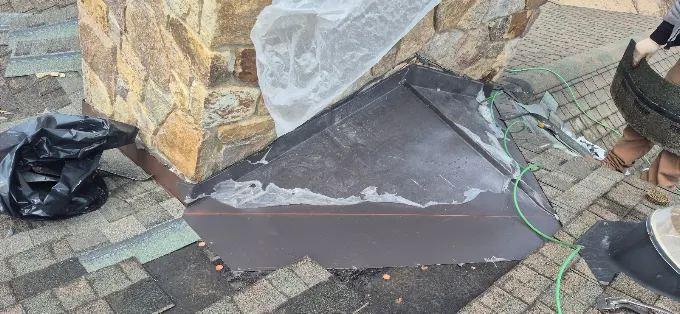
Flashing, done properly
The most common job
We strip the old flashing back, cut a proper reglet into the mortar joint, set step flashing with the shingle courses, install counter flashing into the cut, and seal it with the right sealant — not whatever was on the truck.
On a re-flash we photograph the deck before we close it up, so you can see whether the water has already got into the sheathing.
- Step and counter flashing in the correct sequence
- Reglet cut into the mortar, not surface-caulked
- Copper or aluminium depending on the roof and the masonry
- Photographed before and after
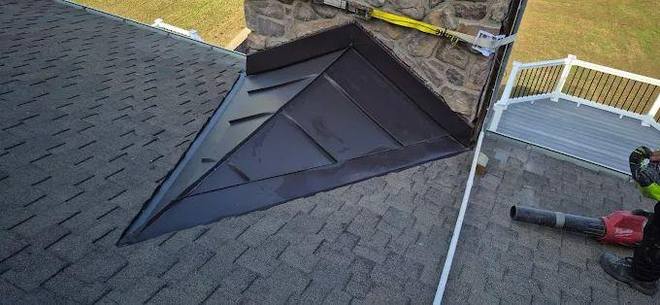
Crickets and saddles
For wide chimneys
Any chimney more than 30 inches wide across the slope wants a cricket behind it. Plenty of houses around here do not have one, and the tell is a dark stain on the ceiling below and a soft spot in the deck behind the stack.
We frame it, sheath it, flash it into the chimney and tie it back into the roof so the water splits and runs past instead of sitting.

Full roof replacement
When patching stops making sense
If the roof is at the end of its life there is no sense in flashing a new chimney into it. We tear off, inspect and replace the deck where it has gone soft, install ice-and-water at the eaves and valleys, underlayment, and the shingle you choose — and we detail the chimney properly on the way past.
The advantage of having us do it: the chimney does not become an argument between two contractors, because there is only one.
- Tear-off and deck repair, not a layover
- Ice and water shield at eaves, valleys and around the chimney
- Ridge venting and intake checked while we are up there
- Chimney flashed properly as part of the job, not an add-on
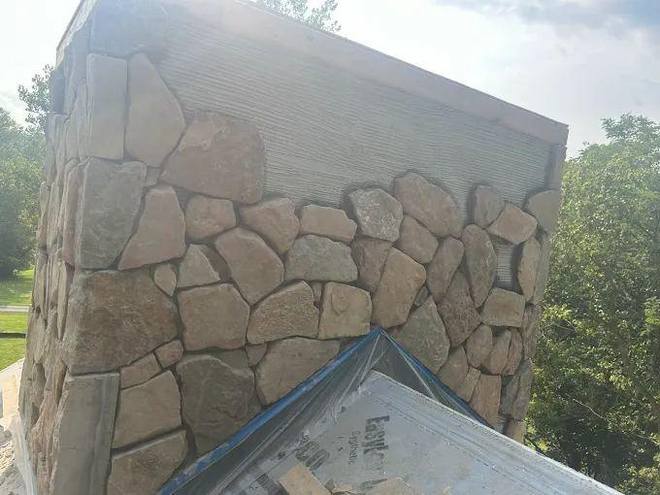
Emergency tarping
When it is coming in now
If water is actively getting in, we can get a tarp on it and stop the damage while we work out the permanent fix and the insurance side of it. Call the office — do not wait for the next dry spell to think about it.
Why Us For This
One Trade, Not Two
If you have a stain on the ceiling near the chimney
Do not assume it is the chimney and do not assume it is the roof. Have somebody put a camera up the flue and eyes on the flashing at the same visit. Chasing the wrong one is how people spend money twice.
Next Step
Find Out Where It Is Actually Coming In
We will look at the chimney, the crown, the cap and the flashing in one visit, and you get the photographs. See inspections and sweeping for what that includes.